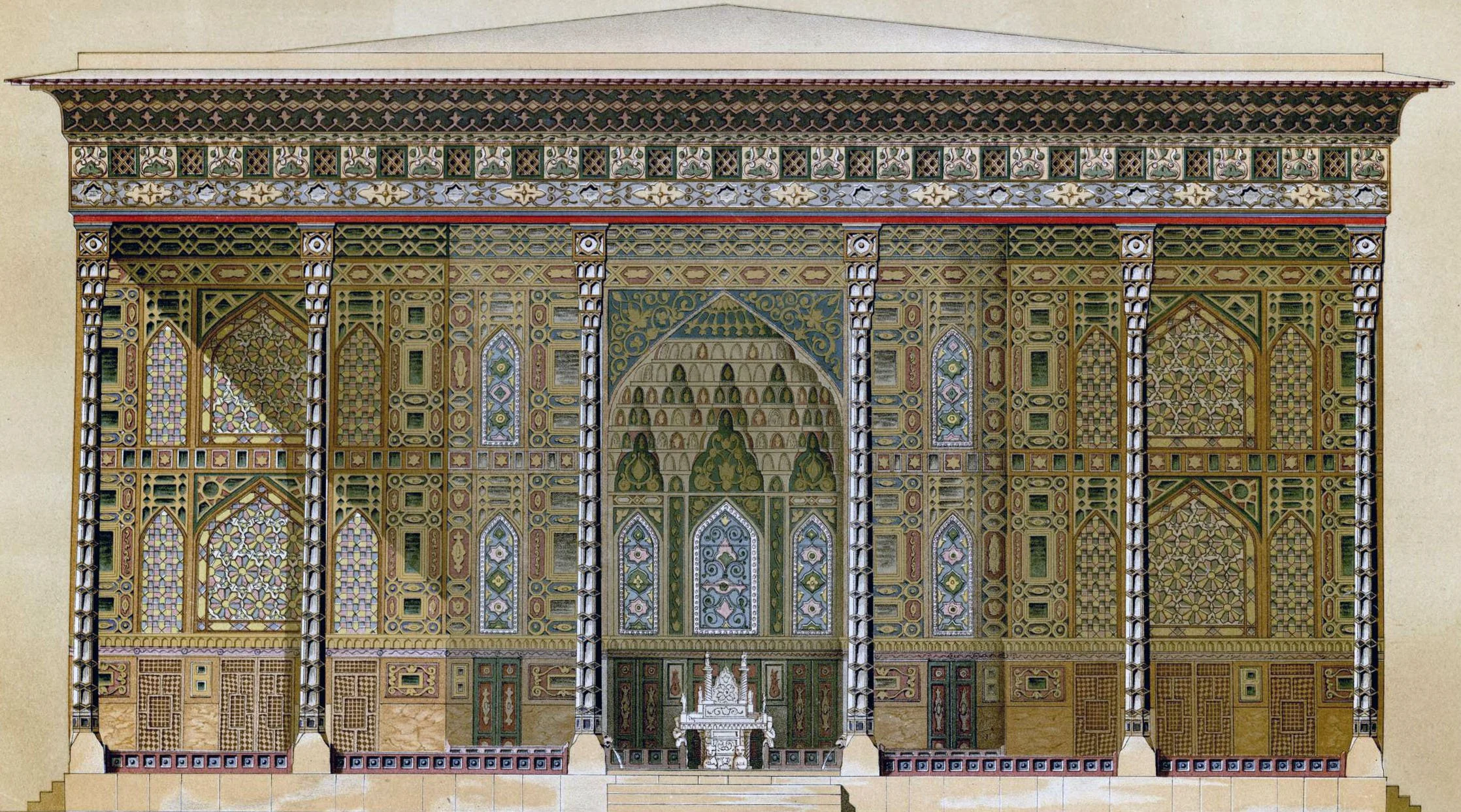
Chehel Sotoon (Fourty Columns)
The Pavilion of Forty Columns: Where Earth Meets Sky. If the heart of Iran beats in its history, then Isfahan is surely its jewel. Known traditionally as Nesf-e-Jahan (Half the World), Isfahan represents the pinnacle of Persian urban design, where turquoise domes and grand boulevards create a living masterpiece of symmetry and light. At the centre of this emerald city sits Chehel Sotoon, a Safavid-era pavilion that defines the "Great Garden" tradition.
The name, meaning "Forty Columns," is a poetic riddle: the twenty slender wooden pillars of the pavilion are reflected in the long, still pool in front, creating the illusion of forty. This site is more than an architectural wonder; it is a sacred space where the interior world of royal murals meets the exterior world of nature. For our founder, Isfahan holds a special place in the heart—it is a city that reminds us of the height of our civilization's elegance and the sophisticated spirit of our ancestors.
The Restoration Roadmap: A Masterplan for Chehel Sotoon To restore Chehel Sotoon is to handle the very fabric of Safavid history. Our strategy for this site focuses on the delicate balance of wood, water, and wall, ensuring every detail is treated with absolute undeniable attention.
Phase 1: Hydrological & Structural Stabilization The soul of Chehel Sotoon is its reflection. We must first address the health of the central pool and the water systems that feed the garden, ensuring the foundations remain stable against moisture and soil shifts.
The Mission: Monitoring the load-bearing wooden columns and stabilizing the stone plinths to prevent further leaning or structural fatigue.
Phase 2: Forensic Conservation of the Safavid Murals The interior of Chehel Sotoon houses some of the most significant historical paintings in the Middle East.
The Mission: Using non-invasive multispectral imaging to see beneath layers of dust and previous "patches."
The Goal: To meticulously clean and stabilize the pigments of the grand frescoes, restoring the vibrant golds and deep blues of the 17th century without erasing the natural patina of time.
Phase 3: The Assembly of the Wood & Pigment Guild We are calling upon a specialized collective of experts to lead this delicate revival:
Master Woodworkers: Experts in Chenar (plane tree) wood to treat and preserve the twenty massive columns.
Mural Conservators: Specialists in Safavid-era mineral pigments and gold leaf application.
Landscape Architects: Experts in the "Persian Garden" (Bagh) layout to ensure the flora matches the original Safavid botanical designs.
Phase 4: Authentic Material Sourcing We go to the source to find the materials that built the Safavid Empire.
The Mission: Sourcing traditional oils and resins to protect the wooden structures from the elements, and finding the specific minerals required to match the historic paint palette.
The Philosophy: We do not use modern synthetics where ancient wisdom serves better. We honor the original artisans by using their methods.
Phase 5: Digital Preservation & The Guardians of Isfahan Because Chehel Sotoon is a UNESCO site, our transparency must be absolute.
The Mission: Creating a virtual archive of every mural and column, allowing the global community to watch the restoration in real-time.
The Call: We invite Financiers and Historians who share a love for Isfahan to join us as "Guardians of the Pavilion," ensuring this jewel of Iran shines for another four centuries.
Join the Mission: "In Isfahan, every stone tells a story of perfection. We are here to ensure those stories are never silenced." If you have questions about our work in Isfahan or wish to contribute your expertise or support to the Chehel Sotoon project, please reach out. We welcome all who are ready to help our heritage rise again—email us at zarathustraheritagesociety@gmail.com to start the conversation.
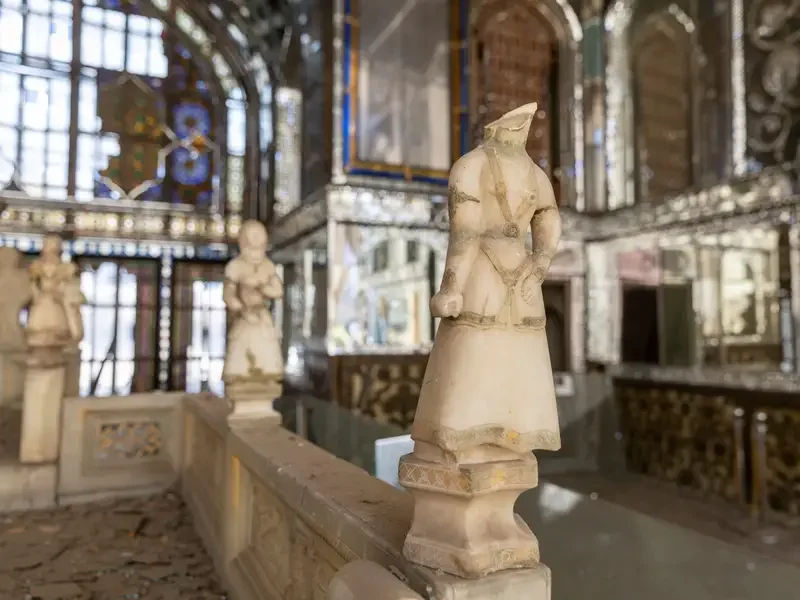
GOLESTAN PALACE
It All Begins Here
The Heart of Tehran: A Monument to Resilience
Golestan Palace, or the "Palace of Flowers," is a UNESCO World Heritage site and the crown jewel of the Qajar era. For over 200 years, it served as the seat of Persian power and the birthplace of modern Iranian art. Its walls represent a rare, masterful fusion of traditional Persian craftsmanship—intricate tilework, Orosi latticework, and the legendary Hall of Mirrors—with the bold architectural influences of the West.
Recently, the shockwaves of conflict have left their mark on this sanctuary. Shattered mirrors, damaged wooden doors, and fallen ornaments now lie where royal ceremonies once took place.
Restoring the "Soul" of the Stone
When a monument is damaged, the world does not just see a structure in ruins; it sees a call to prove that human history cannot be erased by a single tragedy. Across the globe, landmark restorations have demonstrated that with enough resolve, the masterpieces of the past can rise again, stronger and more radiant. At Project Zarathustra, we believe the heritage of the Iranian plateau deserves this same level of global devotion, executed with a level of precision that is uniquely Persian.
Authenticity Over Erasure: We do not seek to simply "patch" walls to hide the pain. We strive for absolute perfection, utilizing the same traditional materials and ancient techniques that the original masters intended. Our dedication to historical accuracy is undeniable, ensuring that every stone and tile is returned to its rightful place.
A Living History: We believe that the scars of war should not be hidden, but understood through the lens of meticulous restoration. Our goal is to restore our sites so perfectly that the transition between the original and the reborn becomes a testament to our survival.
A Legacy of Excellence: We rebuild because resilience and artistry are woven into the Persian DNA. We approach the restoration of Golestan and our other heritage sites with an intensity of detail that reflects our utmost respect for our ancestors. Just as the Phoenix rises, these landmarks will be restored—not merely as museums of the past, but as a reminder that our dedication to perfection is more powerful than anything that tries to tear us down.
The Restoration Roadmap: A Masterplan for Golestan
To restore the "Palace of Flowers" with the dignity it deserves, we have developed a five-phase strategic plan rooted in the highest global standards of architectural conservation. This is not a simple renovation; it is a scientific and artistic resurrection.
Phase 1: Structural Stabilization & Forensic Documentation
Before a single decorative element is touched, the site must be secured.
The Mission: Implementing structural monitoring systems to assess the impact of recent tremors and conflict.
The "Archaeology of Debris": Every fallen fragment—shattered mirror, hand-painted tile, and carved wood—is meticulously collected, GPS-tagged, and archived. These original pieces are the DNA of our reconstruction.
Phase 2: Digital Twin & 3D Heritage Mapping
We utilize cutting-edge technology to ensure mathematical perfection.
The Mission: Deploying high-resolution LIDAR and drone-based photogrammetry to create a millimeter-perfect 3D digital model of the damaged halls.
The Goal: This "Digital Twin" allows our historians and architects to simulate restoration techniques virtually, ensuring that the physical work is flawless before it begins.
Phase 3: The Assembly of the "Master’s Guild"
A project of this magnitude requires a global collective of elite specialists. We are issuing an open call for:
Mirror Artists (Āyeneh-kāri): Masters of geometric glass-cutting to recreate the celestial light of the Qajar era.
Heritage Project Managers: Leaders capable of coordinating international logistics, multi-year timelines, and diverse expert teams.
Specialized Historians: Scholars focused on the 18th and 19th-century Persian aesthetic to verify every pattern and pigment.
Conservation Scientists: Experts in stabilizing ancient masonry and preserving fragile mineral-based murals.
Phase 4: Authentic Material Sourcing & Traditional Techniques
We reject modern shortcuts. Our commitment is to the original "recipe" of the palace.
The Mission: Reopening the historic quarries and kilns used centuries ago to source authentic stone and cobalt-blue tiles.
The Philosophy: If a beam was hand-hewn in the 1800s, its replacement will be hand-hewn today. We preserve the "soul" of the building by using the same tools as the original masters.
Phase 5: The Founding Guardians & Financial Stewardship
A monument of this scale requires a dedicated syndicate of visionaries.
The Mission: We are seeking Financiers and Philanthropists to serve as the "Founding Guardians" of this restoration.
Transparency: Every contribution is tied to a specific hall or architectural element, ensuring that our donors can see the literal stones they have helped put back in place.
Join the Mission
"Resilience is the courage to rebuild authentically, ensuring the scars of the past become the strength of the future."
Are you a Project Manager who can lead a historic timeline?
Are you an Artist who understands the spirit of Persian glass and tile?
Are you a Philanthropist who wants to be remembered as a protector of human history?